


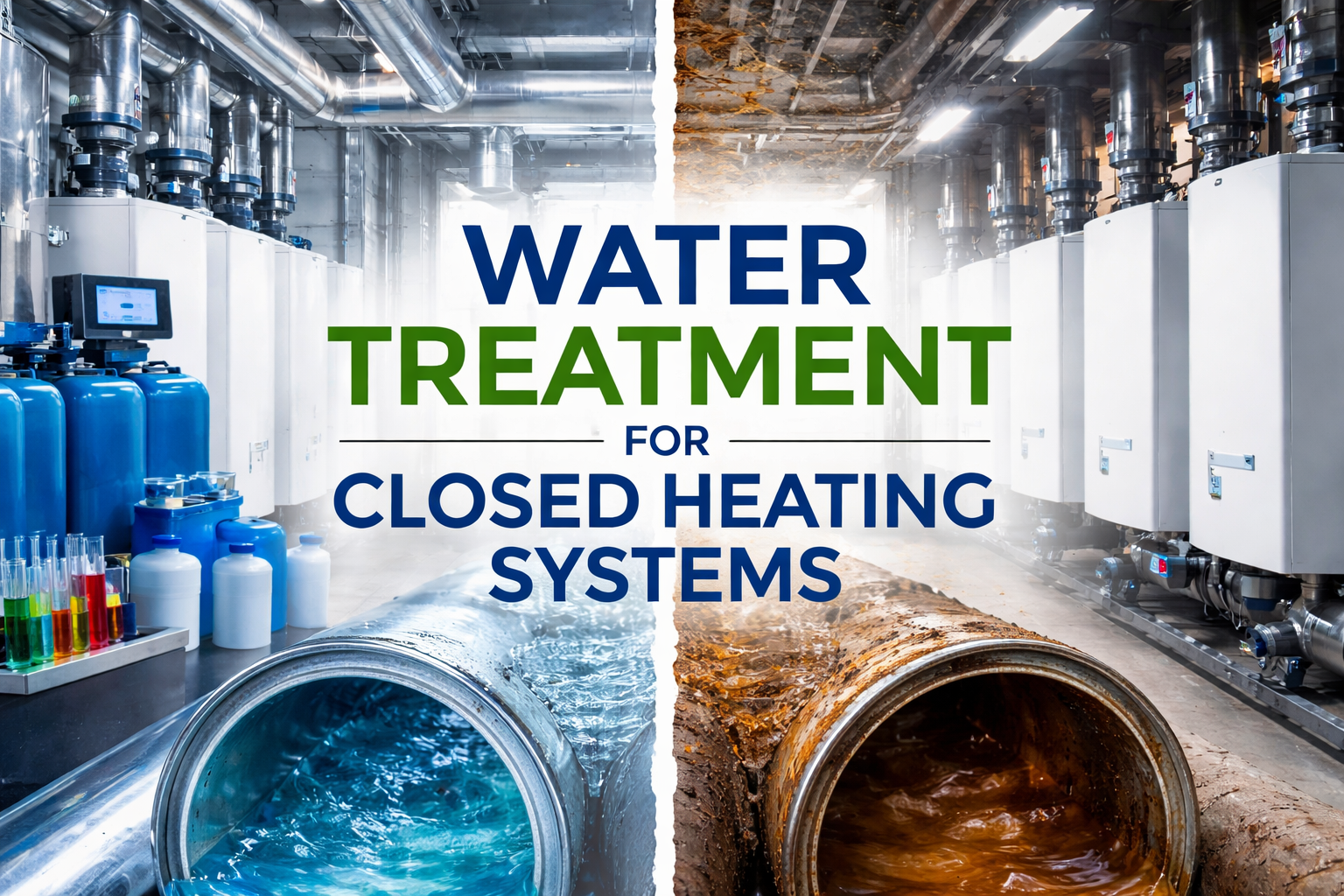
BG29 (Pre-Commission Cleaning of Pipework Systems) sets out best practice for cleaning commercial heating and cooling pipework before it is handed over.
When new systems are installed, they contain:
Mill scale from steel pipework
Jointing compounds and flux residues
Installation debris
Construction dust and particulates
If not properly removed, these contaminants:
Block strainers and control valves
Damage pumps
Reduce heat exchanger efficiency & accelerate corrosion
BG29 ensures systems are thoroughly flushed, cleaned (mechanically and chemically where required), and verified before commissioning.
In simple terms:
BG29 makes sure your heating system starts life clean — not contaminated.
Skipping or rushing this stage often leads to years of ongoing problems.
What Is BSRIA BG50?
While BG29 focuses on pre-commission cleaning, BG50 (Water Treatment for Closed Heating and Cooling Systems) covers ongoing water quality management throughout the system’s life.
Even a perfectly cleaned system will deteriorate without control of:
Corrosion
Oxygen ingress
Sludge (magnetite) formation
Scale
Microbiological fouling
BG50 provides guidance on:
Water chemistry management
Inhibitor dosing
Filtration and solids removal
Monitoring and sampling regimes
Fill water assessment
Oxygen control strategies
It recognises that closed systems are not “fit and forget” — they require structured monitoring.
Why Closed Heating Systems Fail
Most failures can be traced back to five common issues:
1. Oxygen Ingress
Closed systems should not continually draw in fresh water.
Frequent top-ups introduce oxygen, which accelerates corrosion and magnetite formation.
Automatic filling loops can mask underlying leaks — slowly damaging the system.
2. Poor Water Chemistry Control
If inhibitor levels drop or pH drifts out of range:
Steel corrodes
Copper becomes unstable
Aluminium components can be damaged
Sludge accumulates
Without testing, this often goes unnoticed.
3. No Monitoring Programme
BSRIA guidance aligns with BS 8552, which emphasises routine sampling and analysis.
You cannot manage what you don’t measure.
Typical monitored parameters include:
pH
Conductivity
Inhibitor residual levels
Iron levels
Suspended solids
Make-up water trends
Trend analysis is key — not just “pass or fail.”
4. Inadequate Filtration
Modern heating systems have smaller waterways and more sensitive components.
Magnetic filtration and sidestream filtration are often essential to:
Capture magnetite
Prevent plate heat exchanger fouling
Protect pumps and valves
5. Incorrect Fill Water
Mains water may contain:
High hardness
Elevated chlorides or sulphates
Dissolved solids
In some systems, pre-treatment (softening or demineralisation) may be required to prevent long-term damage.
A properly managed commercial heating system should have:
✔ Documented BG29 cleaning records
✔ Evidence of chemical dosing and stabilisation at handover
✔ A defined water treatment specification
✔ Regular sampling regime
✔ Make-up water monitoring
✔ Filtration strategy
✔ Clear responsibility for water quality management
If these elements are missing, risk increases significantly.
The Business Impact of Poor Water Quality
Failure to maintain water quality can result in:
Increased energy consumption
Boiler inefficiency
Plate heat exchanger fouling
Pump failures
Blocked control valves
Emergency shutdowns
Expensive system flushing or component replacement
In severe cases, entire systems require chemical cleaning years after installation — something that should have been prevented at handover.
The Long-Term Value of Proper Water Treatment
Implementing BG29 and BG50 guidance:
Protects capital plant
Extends system lifespan
Maintains energy efficiency
Reduces reactive maintenance
Supports warranty compliance
Demonstrates due diligence
For building owners and facilities managers, this is about asset protection and cost control — not just compliance.
Final Thoughts
Closed heating systems are often assumed to be low-risk compared to cooling towers or domestic water systems. In reality, they can quietly deteriorate if not managed correctly.
BSRIA guidance provides a structured, lifecycle approach:
Clean it properly (BG29).
Control it correctly (BG50).
Monitor it consistently.
When these principles are followed, closed systems operate efficiently and reliably for many years.





Leave a Reply
You must be logged in to post a comment.