VDI 2035 Training

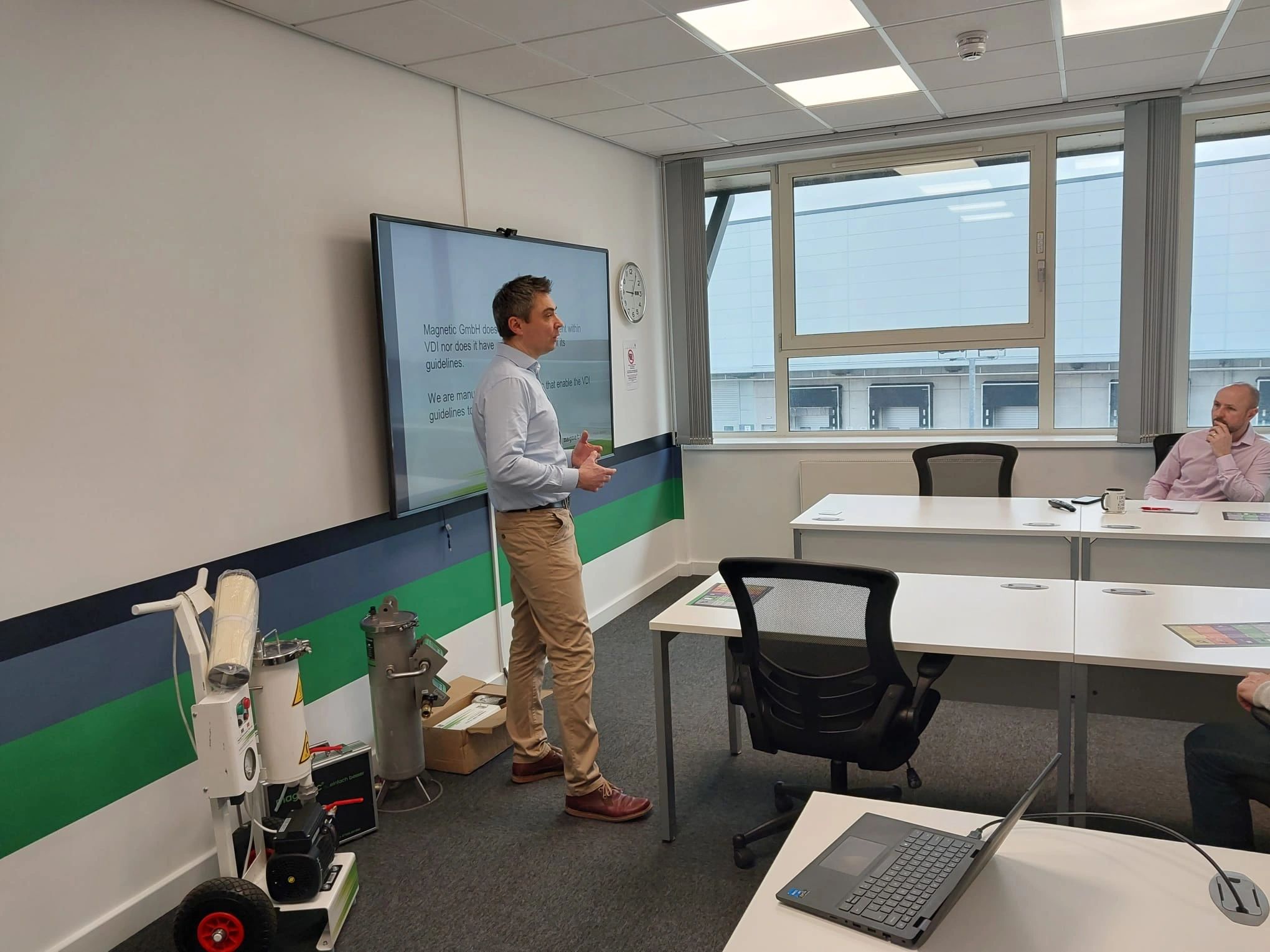
Many thanks to Terry Harvey from Magnetic for the training session he delivered to our Management Team today.
Who is the VDI?

Taken from Magnetic’s website – link to page – https://www.magnetic-online.de/en/vdi-2035

Verein Deutscher Ingenieure (VDI) (English: Association of German Engineers) is an organization with over 150,000 engineers and natural scientists. More than 12,000 honorary experts process the latest findings every year to promote the technology location. Established in 1856, the VDI is today the largest engineering association in Western Europe. The role of the VDI in Germany is comparable to that of the American Society of Civil Engineers (ASCE) in the United States or Engineers Australia (EA) in Australia barring the broader field of work of the VDI. The VDI is not a union. The association promotes the advancement of technology and represents the interests of engineers and of engineering businesses in Germany.

Source: wikipedia

Theory and practice

Theory and practice

If the heating is properly filled, no deposits can form and the corrosion is reduced to a minimum. Should damage nevertheless occur, there are various reasons. The causes of heating damage can be: Too much oxygen in the water, mud has formed or/and the ph is in the acidic range.


But what does “properly filled” mean?

The VDI guideline published by the Association of German Engineers (VDI)2035 places demands on the fill water, both the scale formation as well as (the oxygen as well) affect electrical conductivity. A Pure water softening is therefore not sufficient.

Which parameters should therefore be considered?

electric conductivity at 25° CµS/cm< 100
german hardness at 25° C°dH< 3
pH value at 25 ° C 8,2 – 10 / 8,2 – 9,0 (aluminium)

See more details on the Magnetic website as per link above.

Leave a Reply

Find out how we can help you!

With our extensive experience in Legionella Risk Assessment Services & Water Treatment Services Contact us today to find out how we can help you.

Contact Us

What Is BSRIA BG29 & BG50?

BG29 (Pre-Commission Cleaning of Pipework Systems) sets out best practice for cleaning commercial heating and cooling pipework before it is handed over. When new systems are installed, they contain: Mill scale from steel pipework Jointing compounds and flux residues Installation debris Construction dust and particulates If not properly removed, these contaminants: Block strainers and control… Read more »

Le Mans Crescent Project!

Major Mechanical Installation Project Underway at Le Mans Crescent, Bolton We’re proud to be delivering a significant mechanical installation project at Le Mans Crescent in Bolton, and it’s fantastic to see the works progressing well as the building services infrastructure begins to take shape on site. This phase of the project represents a key milestone… Read more »

Thermostatic Mixing Valves (TMVs): Understanding TMV2, TMV3 and Your Legal Responsibilities

Thermostatic Mixing Valves (TMVs) play a critical role in controlling water temperature and reducing the risk of scalding in both domestic and commercial buildings. In higher-risk environments such as healthcare, care homes and education settings, correct valve selection, installation and ongoing maintenance is not just best practice – it is a legal and moral responsibility…. Read more »

How Passing TMVs Drive Legionella and Biofilm Formation

Passing TMVs create the exact conditions Legionella bacteria thrive in. The combined effects include: Once temperature control is lost, biofilm rapidly develops on internal pipe surfaces. Biofilm acts as: As biofilm thickens, it further restricts flow, worsening stagnation and creating a self-reinforcing cycle that accelerates colonisation. In many investigations of persistent Legionella positives, passing TMVs… Read more »