


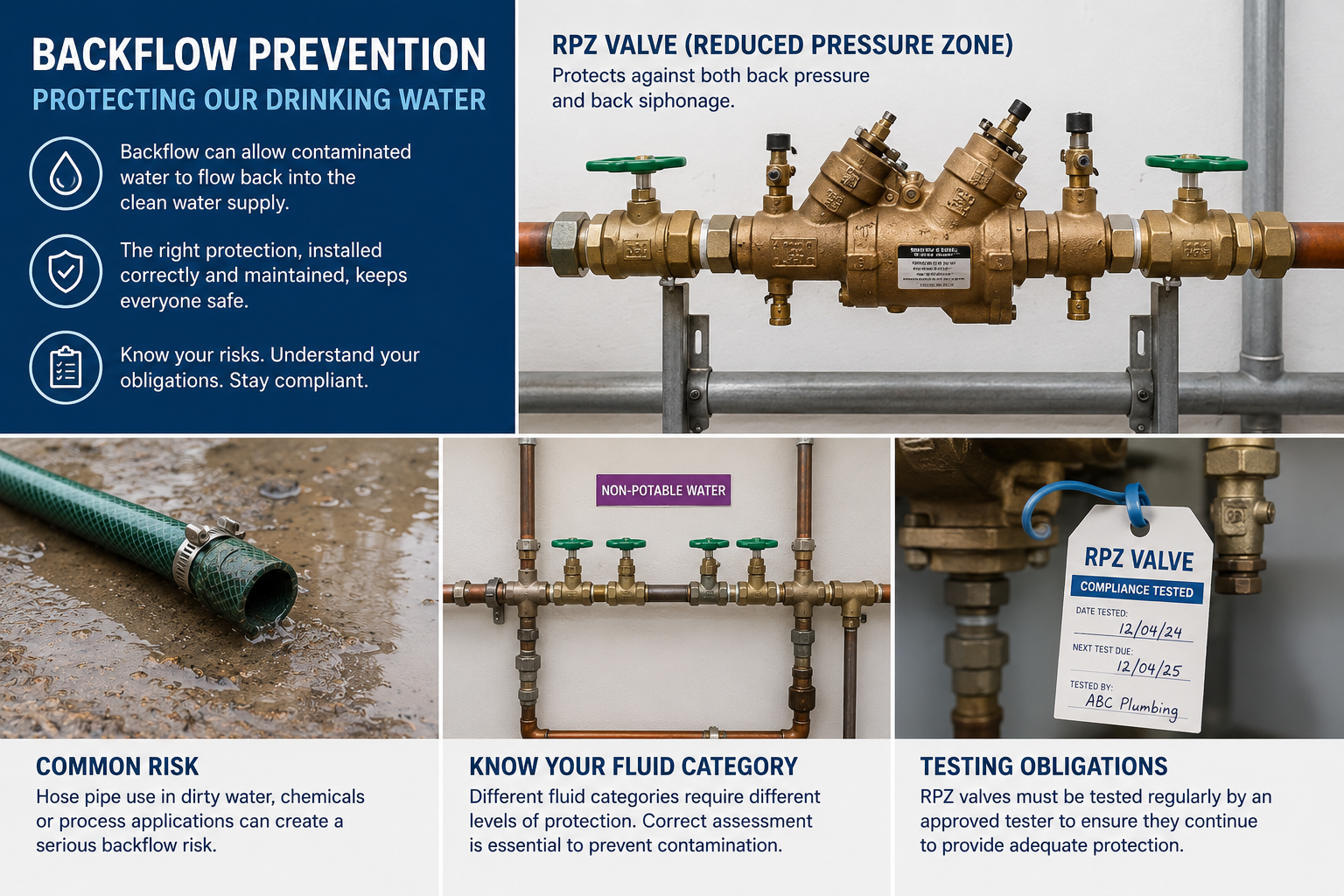
Protecting Drinking Water from Contamination
Backflow prevention is one of the most important aspects of water system design and compliance. Every year, businesses, healthcare facilities, schools, hotels, and industrial sites invest in plumbing systems to deliver clean drinking water throughout their premises. However, without adequate backflow protection, contaminated water can potentially enter the wholesome water supply.
The UK Water Supply (Water Fittings) Regulations 1999 require plumbing systems to be designed and maintained to prevent contamination through backflow. Failure to comply can result in enforcement action by the local water undertaker and, more importantly, can create significant public health risks. (See https://www.legislation.gov.uk/uksi/1999/1148)
What is Backflow?
Backflow occurs when water flows in the opposite direction to its intended path, allowing contaminated water to enter the drinking water system. This can happen through:
Back Siphonage
When a drop in mains pressure creates a vacuum effect, potentially drawing contaminated water back into the supply.
Examples include:
- Burst water mains
- Firefighting operations
- Emergency shutdowns
- High demand on local networks
Back Pressure
When downstream pressure becomes greater than the incoming mains pressure, forcing water back towards the supply.
Examples include:
- Booster pumps
- Pressurised systems
- Industrial processes
- Heating systems
Both scenarios present a risk of contamination and must be controlled through suitable backflow prevention measures.
Understanding Fluid Categories
The Water Supply (Water Fittings) Regulations classify water into five fluid categories based on the potential risk to health.
Fluid Category 1
Wholesome drinking water supplied directly from the water undertaker.
Examples:
- Drinking water outlets
- Potable cold water systems
Fluid Category 2
Water whose quality has been altered but does not present a health hazard.
Examples:
- Heated water
- Water with minor aesthetic changes
Fluid Category 3
Water presenting a slight health hazard due to low-toxicity substances.
Examples:
- Cold water storage tanks
- Commercial dishwashers
- Some process equipment
Fluid Category 4
Water presenting a significant health hazard.
Examples:
- Chemical dosing systems
- Commercial vehicle wash systems
- Fire sprinkler systems with additives
- Certain industrial processes
Fluid Category 5
Water presenting a serious health hazard due to microbiological or toxic contamination.
Examples:
- Sewage systems
- Clinical waste processes
- Mortuary equipment
- Certain laboratory applications
The higher the fluid category, the greater the level of backflow protection required.
Common Backflow Risks in Commercial Buildings
Backflow risks are often identified during water hygiene surveys, Legionella risk assessments, and plumbing inspections.
Typical examples include:
- Hose union taps without adequate protection
- Chemical dosing equipment
- Commercial kitchens
- Vehicle wash facilities
- Irrigation systems
- Fire suppression systems
- Laboratory sinks
- Dental equipment
- Healthcare decontamination equipment
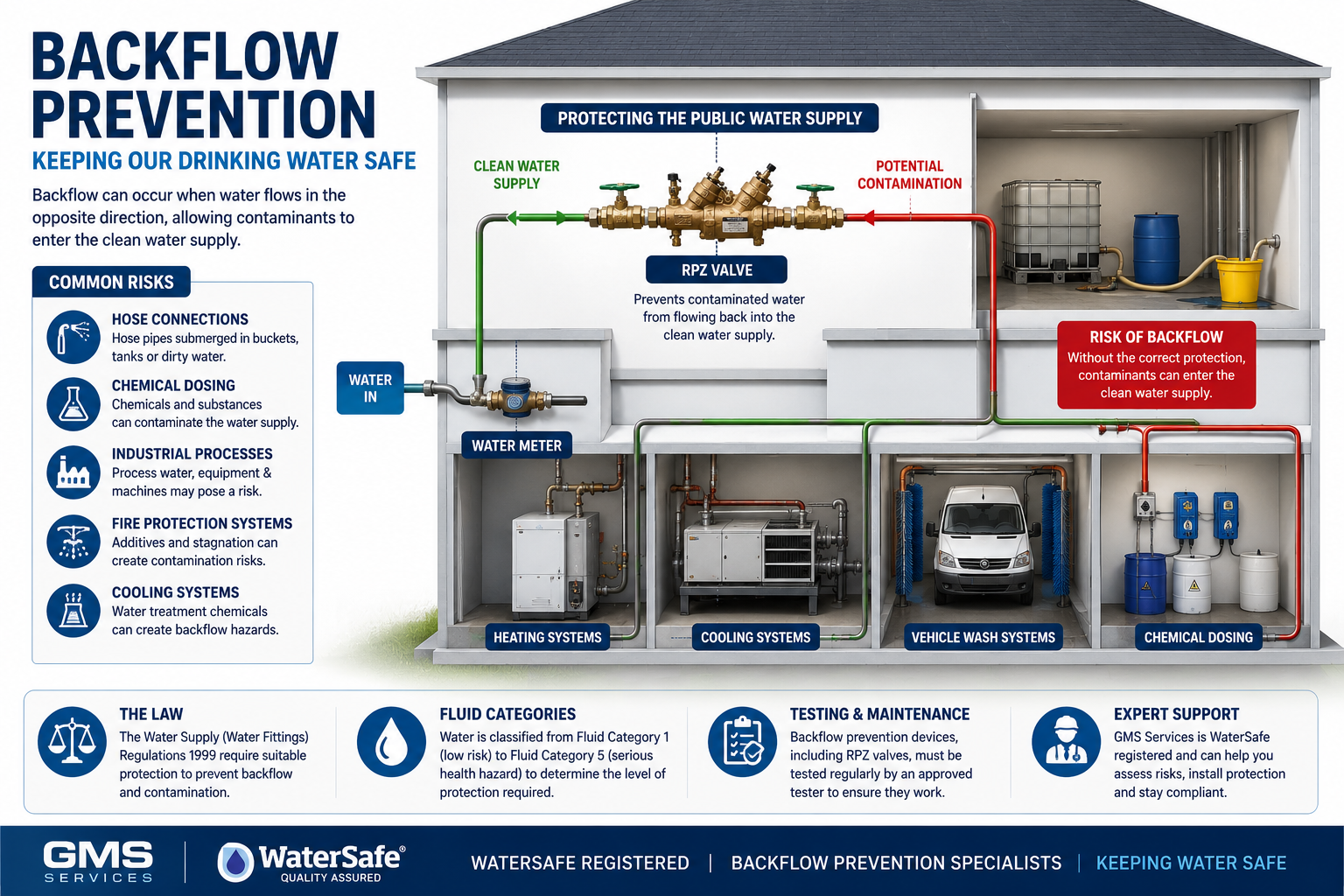
Without suitable protection, contaminants can potentially enter both the building’s water system and, in some cases, the public water supply.
What is an RPZ Valve?
A Reduced Pressure Zone (RPZ) Valve, also known as a BA Device, is a specialist mechanical backflow prevention device designed to protect against both back pressure and back siphonage.
RPZ valves are recognised as providing protection up to and including Fluid Category 4 risks. They are commonly installed where significant health hazards have been identified but where a Fluid Category 5 air gap arrangement is not required.
Typical RPZ Applications
- Commercial vehicle wash systems
- Irrigation systems
- Fire sprinkler systems with additives
- Industrial process equipment
- Chemical dosing installations
- Manufacturing facilities
RPZ Valve Regulatory Requirements
Unlike many other plumbing fittings, RPZ valves are subject to strict regulatory controls.
Requirements include:
Water Undertaker Approval
Before installation, the local water company must generally be notified and consent obtained.
Approved Installation
RPZ valves must be installed in accordance with the Water Regs UK Approved Installation Method (AIM).
Commissioning
The valve must be tested and commissioned before being placed into service.
Ongoing Compliance Testing
RPZ valves must undergo regular compliance testing by a competent approved tester. Test intervals are determined by the water undertaker but are typically annual as a minimum.
Testing Obligations
Many duty holders are unaware that installing an RPZ valve creates an ongoing legal obligation.
Regular testing is required because:
- Internal check valves can wear
- Debris can prevent correct operation
- Relief valves can fail
- Mechanical components deteriorate over time
A failed RPZ valve may no longer provide adequate protection against contamination.
Testing must be carried out using approved equipment by a competent RPZ tester, with results submitted to the relevant water undertaker where required.
WRAS and Water Regulations Compliance
Many people assume that installing a WRAS-approved fitting automatically guarantees compliance.
In reality, compliance depends on both:
Product Compliance
Using fittings that comply with relevant water regulations and approval schemes.
Installation Compliance
Ensuring equipment is correctly selected, installed, commissioned, and maintained for the specific fluid category risk.
A WRAS-approved product can still be non-compliant if installed incorrectly or used in the wrong application.
Why Use a WaterSafe Registered Contractor?
WaterSafe is the UK’s national register of approved plumbing professionals and businesses recognised by the water industry.
Using a WaterSafe registered contractor provides reassurance that work is being carried out by individuals who understand:
- Water Supply (Water Fittings) Regulations
- Backflow prevention requirements
- Fluid category assessments
- Notification requirements
- Industry best practice
GMS Services – WaterSafe Registered
As a WaterSafe registered company, GMS Services provides:
- Backflow prevention surveys
- Fluid category assessments
- RPZ valve inspections
- RPZ valve testing coordination
- Water regulations compliance support
- Commercial plumbing remedial works
Our engineers help clients identify risks, achieve compliance, and protect their drinking water systems from contamination.
Conclusion
Backflow prevention is not simply a regulatory requirement—it is a critical safeguard for public health.
Understanding fluid categories, selecting appropriate protection, maintaining RPZ valves, and ensuring compliance with the Water Supply (Water Fittings) Regulations are all essential responsibilities for building owners and duty holders.
By taking a proactive approach to backflow prevention, organisations can protect occupants, maintain compliance, and safeguard the integrity of their water systems.
Need advice on backflow prevention or RPZ valve compliance?
GMS Services provides WaterSafe-registered commercial plumbing services, water regulations compliance surveys, RPZ valve support, and backflow prevention solutions across healthcare, education, hospitality, industrial, and commercial environments throughout the UK. Contact our team to arrange an assessment of your water system.




Leave a Reply
You must be logged in to post a comment.